
Your Strategy was written for a world that no longer exists.
Here's what to do about it.
Patterns of Strategy
An in-person working session with Patrick Hoverstadt
April 17, 2026
Cincinnati, OH
8:30pm-4:00pm ET
Let's be honest about what the last ninety days
have actually been.
For most leadership teams, Q1 2026 didn't go the way the strategy expected it would. The assumptions the plan was built on - about competive position, about market stability, about what the next twelve months would look like - have shifted. Some shifted fast. Some shifted in ways nobody predicted six months ago.
And now your in the position most senior leaders find themselves in but rarely say out loud: you're not sure the strategy still fits the world it was written for, and you don't have a framework for figuring out what to do about it.
This is not a problem of execution but of approach. The underlying assumptions are changing faster than the team can respond.
And frankly, it's the predictable outcome of using tools that were never designed for the environment you are actually operating in.
Strategy won't deliver if it's based on faulty design.
Here is the number that should have ended the strategy consulting industry:
Around 90% of strategic plans are never implemented.
Not 20%. Not 40%. Ninety percent.
Think about what that means. An entire industry built around a tool that fails nine times out of ten.
And the response from that industry is to recommend better execution, stronger change management, more rigorous planning.
If your car failed to start nine times out of ten, you wouldn't hire a better driver. You'd question whether the car works at all.
The strategy tool is the problem. Not your team. Not your execution. The framework.
Why Traditional Strategy is Broken
Conventional strategy is built on assumptions that are fundamentally broken.
Assumption #1: The Destination Exists
Strategy is framed as a journey from A to B. Define where you are. Define where you want to be. Plan the route. The problem is that B doesn't exist yet. The future gets built simultaneously by your competitors, your customers, your regulators, and a dozen other actors — all making decisions that interact with yours in ways no planning process can predict. By the time you arrive at B, the actors who didn't care what your plan said have already built something different in its place.
Assumption #2: You Are the Only One Moving
Most conventional frameworks model your organization's position, your capabilities, your moves. Competitors and customers appear as backdrop — not as active agents making their own choices, running their own strategies, adapting in real time. If ten significant actors are operating in your strategic environment and each has a roughly equal chance of disrupting your plan, you have — at best — a one-in-ten chance of executing strategy as written.
Now imagine driving down a busy motorway the way most organizations do strategy — focusing entirely on your destination and ignoring every other driver around you. You wouldn't make it more than a few kilometers before crashing. That's not an extreme analogy. That's a description of how conventional strategy actually functions. Everyone else on the road is treated as scenery.
Assumption #3: Time is a Gantt Chart
Most strategy has no meaningful time dimension. But strategic environments move at different speeds. Your competitors may be running quarterly cycles while you're on an annual plan. A faster competitor in a slower market has a very different strategic position than a faster competitor in an already fast-moving one. Most frameworks give you no way to even ask the question.
MEET your guide
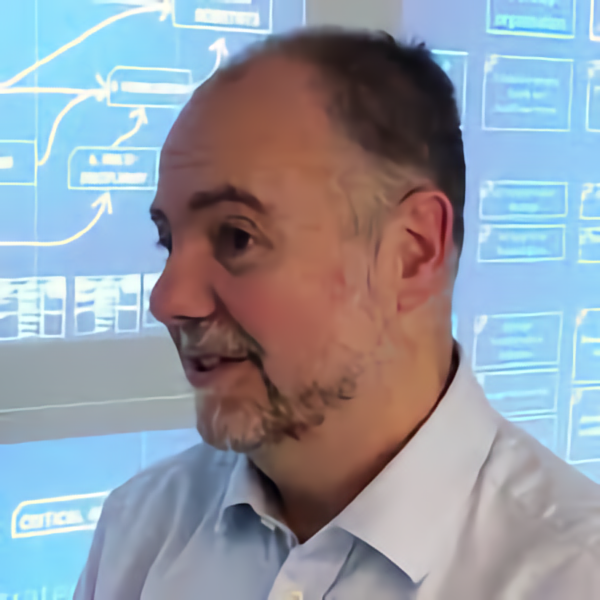
Patrick Hoverstadt
Patrick Hoverstadt didn't develop Patterns of Strategy in a research lab or a business school.
He developed it in live strategic situations — where governments and corporations were simultaneously competing and cooperating, where the conventional tools offered no useful guidance, and where the cost of getting it wrong was real and immediate.
He needed something that worked. What he built, and then spent decades testing and refining across more than a hundred organizations in twenty-four countries, is the result.
He defines strategy precisely: "Changing our fit with the environment to our advantage by concentrating power in time."
Fit. Power. Time. Three dimensions. Most frameworks engage with one of them, incompletely.
Patrick is based in the UK. He works primarily in Europe. Bringing him to Cincinnati for a working session with senior leaders is not something that happens on a regular schedule.
What this framework looks like in practice
Honda-Yamaha Market Battle
The Situation
IIn 1981, Yamaha decided to seize motorcycle market leadership from Honda — building the world's largest motorcycle factory to do it, calculating that scale and cost advantage would push Honda back.
The Manoeuver
Honda responded not by matching power with power, but by changing the dimension of competition entirely. Over the next eighteen months, Honda introduced 130 new motorcycle models. Yamaha managed 37.
The Outcome
Yamaha was left with approximately twelve months of unsold inventory and conceded the battle.
Who Is This For?
You are a founder, CEO, senior leader at an established organization or actively involved in the crafting of your organizations strategy
The last ninety days have made you genuinely uncertain whether your current strategy fits the environment you're now operating in
You've done the strategic planning work and still feel like something structural is missing
You want tools you can apply the following Monday — not principles to contemplate over the following quarter
You value systemic, rigorous thinking and are willing to have your assumptions challenged in a room with other serious people
Introduction to the Patterns of Strategy
This isn't just theory. It's not another framework destined to sit on a shelf.
It's a focused, working session to give you practical tools that world-class organizations use to adapt faster, perform consistently, and lead through uncertainty.
Patrick will introduce the Patterns of Strategy framework. You will bring your actual strategic situaion - the real terrain of your organization - and work with both Patrick and your peers to develop a structural understanding you could not have generated on your own.
You will:
Map structural patterns that shape your current results
Identify specific leverage points in your context
Apply systemic lenses to real challenges facing your organization
Why now?
The organizations that navigate 2026 well won't be the ones with the most detailed plan from last November.
Rapid change requires rapid response. The winners can adapt and pivot as the landscape shifts.
Good strategy understands the environment.
You will not leave with slides to file away. You will leave with a different way of seeing.
Patterns of Strategy Live
1-Day Workship - Cincinnati, OH
April 17, 2026
8:30am-4pm ET
A working session with Patrick Hoverstadt — on your actual strategic situation.
Participants bring their real challenges into the room. The day's work is learning to see those challenges through a different lens — one that accounts for all the actors, the value exchanges, the timing, and the manoeuvres that conventional frameworks either ignore or model poorly. You leave with tools you can apply immediately and a structural read of your situation you couldn't have generated on your own.
Patrick is based in the UK. He is rarely in the US.
This is a unique opportunity. Space is limited.
(C) 2026 Open Eyes Collaborative